
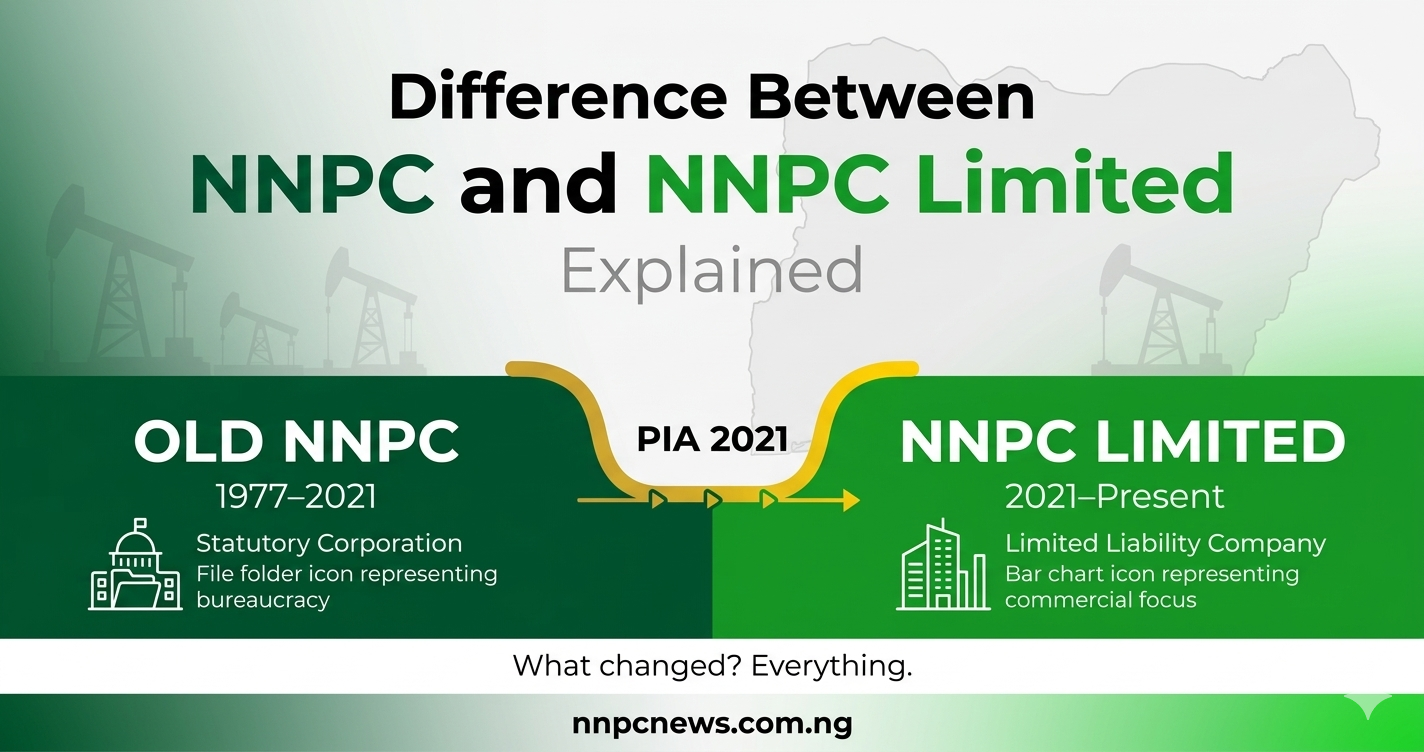
If you’ve been trying to follow Nigerian oil and gas conversations, you’ve probably seen both names thrown around. NNPC. NNPC Limited. Same initials. Same building in Abuja. But not the same thing.
The difference matters more than you’d think. It’s the difference between a government department and a company. Between civil service rules and commercial discipline. Between the old way of doing things and what comes next.
The Short Version
NNPC was the Nigerian National Petroleum Corporation — a statutory corporation established in 1977 under Decree No. 33. It operated as a government entity with budgetary allocations, ministerial supervision, and civil service rules.
NNPC Limited is the Nigerian National Petroleum Company Limited — a limited liability company registered under the Companies and Allied Matters Act. It was created by the Petroleum Industry Act 2021 as the commercial successor to the old corporation.
Same initials. Completely different legal personality. If you’re curious about what NNPC Limited is under the Petroleum Industry Act, that’s the legal foundation for everything that changed.
Legal Status: The Fundamental Difference
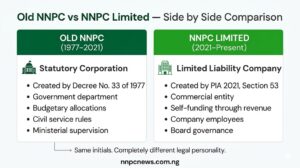
Old NNPC: A Statutory Corporation
The old NNPC was created by a specific act of parliament — Decree No. 33 of 1977, later codified as the NNPC Act. This made it what lawyers call a statutory corporation.
Think of it like this: it existed because the government passed a law saying “there shall be a body called the Nigerian National Petroleum Corporation.” Its powers, its structure, its very existence came from that law.
As a statutory corporation, it was part of the government apparatus. Civil service rules applied. Budgetary allocations came from the National Assembly. The Minister of Petroleum Resources gave direct orders.
NNPC Limited: A Commercial Company
NNPC Limited is different. It’s registered with the Corporate Affairs Commission under the Companies and Allied Matters Act, just like Dangote Cement or MTN Nigeria.
Section 53 of the PIA mandated the Minister of Petroleum Resources to incorporate this new company within six months of the Act’s commencement. They moved fast — within six weeks, NNPC Limited was registered.
This matters because companies operate differently from government agencies. They have shareholders. They must make profit. They’re required to publish audited accounts. Understanding the NNPC ownership structure under Nigerian law helps explain who actually owns it now.
Ownership Structure: Then and Now
Old NNPC: Implicit Government Ownership
The old NNPC was wholly owned by the federal government, but not in the way a company is owned. There were no shares. No share certificates. No formal ownership structure.
The government owned it because the law said so. Simple as that.
NNPC Limited: Formal Shareholding
NNPC Limited has actual shares. Two of them, to be exact:
- Ministry of Finance Incorporated — holds one share
- Ministry of Petroleum Incorporated — holds one share
Both hold those shares on behalf of the federal government. So the government still owns it completely. But now there’s a formal structure. Shares that could theoretically be sold someday. Shareholder rights that must be respected.
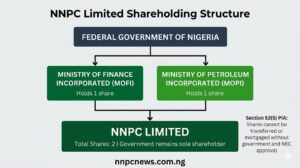
Section 53(5) of the PIA has an important restriction — the shares cannot be transferred or mortgaged unless approved by the government and the National Economic Council. This protects against backdoor privatization without proper oversight.
Governance: Who’s Really in Charge
Old NNPC: Ministerial Supervision
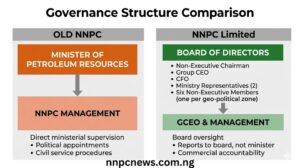
Under the old structure, the Minister of Petroleum Resources had direct supervisory authority. Major decisions required ministerial approval. The board, when it existed, served mostly in an advisory capacity.
Appointments followed civil service procedures. Leadership positions were political decisions. The Minister could give orders, and NNPC followed them.
NNPC Limited: Board Governance
NNPC Limited now has a proper board of directors under Sections 58 and 59 of the PIA. The board includes:
- A Non-Executive Chairman
- A Chief Executive Officer
- A Chief Financial Officer
- A representative each from the Ministry of Petroleum and Ministry of Finance
- Six non-executive members with at least 15 years petroleum industry experience, one from each geo-political zone
The board provides strategic oversight. Management handles day-to-day operations. The Group Chief Executive Officer reports to the board, not to the minister.
In April 2025, President Tinubu carried out a major leadership overhaul. The new board features Ahmadu Musa Kida as Non-Executive Chairman and Bashir Bayo Ojulari as Group Chief Executive Officer. If you’re tracking leadership, knowing who is the GCEO of NNPC matters for understanding where the company is headed.
Funding and Budgeting
Old NNPC: Budgetary Allocations
The old NNPC received annual budgetary allocations from the federal government. Its operations were funded through appropriations approved by the National Assembly.
Think about what that means. If you’re a government department, your funding depends on politics. On budget negotiations. On whether the legislature likes your minister.
There was no real pressure to generate profits. You got your allocation regardless of performance.
NNPC Limited: Self-Funding Through Revenue
NNPC Limited no longer receives government budgetary allocations. It must fund its operations through internally generated revenue and commercial borrowing.
This changes everything. Now the company must actually make money to survive. It must manage costs. It must pursue profitable opportunities.
The Fiscal Responsibility Act, the Public Procurement Act, and the Treasury Single Account do not apply to NNPC Limited’s operations. That’s huge. They can operate like a real company, not a government agency.
What NNPC Limited Can and Cannot Do
Powers the Old NNPC Had
The old NNPC had wide powers under its enabling act. It could engage in all aspects of petroleum operations. It also performed regulatory functions — issuing permits, monitoring compliance, enforcing regulations.
This dual role created obvious conflicts. It was like a football player doubling as the referee.
Powers NNPC Limited Has Now
The PIA separates commercial and regulatory functions. NNPC Limited focuses exclusively on commercial operations. Regulatory functions now reside with:
- Nigerian Upstream Petroleum Regulatory Commission (NUPRC) — oversees upstream activities
- Nigerian Midstream and Downstream Petroleum Regulatory Authority — regulates midstream and downstream operations
But there are also important limits on NNPC Limited’s powers:
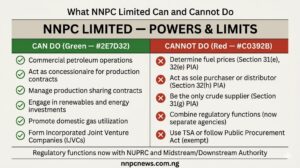
No power to determine fuel prices. Sections 31(e) and 32(e) of the PIA place responsibility for fixing petroleum product prices with the regulatory authority, not NNPC Limited.
Not the sole purchaser or distributor. Section 32(h) gives the authority responsibility for distribution. Independent marketers can purchase directly from refineries like Dangote on their own terms.
Not the only crude supplier. Section 31(g) gives the NUPRC mandate to ensure crude supply to local refineries. NNPC Limited’s role is restricted to dealings in royalty oil, profit oil, and tax oil only.
Financial Performance: The Numbers Tell the Story
The old NNPC was famously opaque. Financial disclosures were limited. Hard numbers were hard to find.
NNPC Limited publishes monthly reports. In 2025, the numbers showed:
| Metric | Value |
|---|---|
| Total Revenue | ₦60.5 trillion |
| Profit After Tax | ₦3.76 trillion |
| Statutory Payments | ₦14.7 trillion |
| Average Crude Production | 1.62 million barrels per day (2025 average) |
| Natural Gas Supply | 6,914 million standard cubic feet per day (December) |
| Upstream Pipeline Availability | 100% |
| AKK Pipeline | 91% |
Between January and October 2025, NNPC Limited remitted ₦12.12 trillion in statutory payments to the federal government. The detailed NNPC financial statements explained show exactly where these numbers come from.
Staff and Employment
Old NNPC: Civil Servants
Employees of the old NNPC were civil servants. Their terms of service followed public service rules. Compensation was determined by government pay scales.
This made it hard to attract specialized talent. A petroleum engineer with global experience could earn much more working for an international oil company than for NNPC.
NNPC Limited: Company Employees
Section 57 of the PIA transferred all employees of NNPC and its subsidiaries to NNPC Limited with the same or similar conditions of service they had before.
But now they’re company employees. Over time, NNPC Limited can adjust compensation based on market requirements. It can design employment terms that support commercial objectives.
Objectives: What They’re Supposed to Do
Old NNPC’s Mandate
The old NNPC had a broad mandate that included commercial operations and policy implementation. It was expected to ensure fuel supply, stabilize prices, and support national development alongside commercial operations.
Policy considerations often took precedence over commercial returns.
NNPC Limited’s Objectives
Section 64 of the PIA lists specific objectives:
- Carry out petroleum operations on a commercial basis
- Act as concessionaire for all production contracts
- Remit proceeds to government less management fee and Frontier Exploration Fund
- Carry out test marketing to determine value of crude oil
- Manage production sharing contracts
- Engage in renewables and other energy investments
- Promote domestic gas utilization
- Maintain the role of NNPC
- Carry out tasks requested by the Commission
- Engage in activities that ensure national energy security
The company is also vested as the concessionaire of all production sharing contracts, profit sharing contracts, and risk service contracts as the national oil company on behalf of the federation.
NNPC Limited and parties to joint operating agreements can voluntarily restructure their agreements as joint ventures carried out by way of limited liability companies, known as Incorporated Joint Venture Companies (IJVCs). These are independent entities with strong commercial orientation and transparent operations.
Transparency Requirements
Old NNPC: Limited Disclosure
The old NNPC was not required to publish audited financial statements. Its financial operations were not subject to public disclosure under standard accounting practices.
This limited transparency made it difficult to assess performance. Stakeholders relied on reports from external bodies like NEITI for information.
NNPC Limited: Mandatory Publication
NNPC Limited must publish audited financial statements annually. The PIA requires transparency in the management of petroleum resources.
Sections 61 and 62 require board members to discharge responsibilities in accordance with the highest standards of corporate governance and ensure annual audit by an independent, competent, experienced, and qualified auditor.
The goal is to move from an organization often described as “opaque” to one that can take its place among corporate giants of repute globally.
Future Outlook
What’s Changed Permanently
The transition from NNPC to NNPC Limited isn’t just a name change. It’s a fundamental shift in how Nigeria’s national oil company operates. The old model of government agency with budgetary allocations is gone. The new model of commercial company with profit obligations is here to stay.
What’s Still Evolving
In late 2025, the government began proposing significant amendments to the PIA. One consequential change would see the NUPRC replace NNPC Ltd as the government’s concessionaire in existing production-, profit- and risk-service contracts.
The amendment would vest all NNPC shares in the Federation, held solely by the Ministry of Finance Incorporated (MOFI), displacing the Ministry of Petroleum Incorporated (MOPI) as co-owner.
This proposal has generated debate. Critics argue it could create conflict of interest, with the regulator becoming both umpire and player.
Targets Going Forward
President Tinubu handed the new board an immediate action plan: conduct a strategic portfolio review of NNPC-operated and Joint Venture Assets to ensure alignment with value maximization objectives.
The administration targets:
- Raising oil production to two million barrels daily by 2027 and three million daily by 2030
- Gas production to eight billion cubic feet daily by 2027 and ten billion by 2030
- Elevating NNPC’s share of crude oil refining output to 200,000 barrels by 2027 and 500,000 by 2030
- Increasing investment from $17 billion (achieved since 2023) to $30 billion by 2027 and $60 billion by 2030.
Summary: Key Differences at a Glance
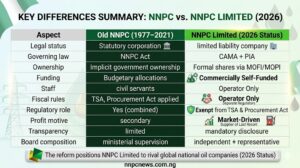
| Aspect | Old NNPC | NNPC Limited |
|---|---|---|
| Legal status | Statutory corporation | Limited liability company |
| Governing law | NNPC Act | CAMA + PIA |
| Ownership | Implicit government ownership | Formal shares via MOFI and MOPI |
| Funding | Budgetary allocations | Commercial operations |
| Staff | Civil servants | Company employees |
| Fiscal rules | TSA, Procurement Act applied | TSA, Procurement Act don’t apply |
| Regulatory role | Yes (combined with commercial) | No (separate agencies) |
| Profit motive | Secondary | Primary |
| Transparency | Limited | Mandatory disclosure |
| Board composition | Ministerial supervision | Independent + representative |
The reform which started with the PIA holds a lot of promise. If well implemented, it could position NNPC Limited to rival the best national oil companies globally. The swiftness shown so far is encouraging. The hope is that politics won’t truncate things.
Official sources for verification:
- • Petroleum Industry Act 2021 on the FAO Legal Database
- • Nigerian Upstream Petroleum Regulatory Commission (NUPRC)
Last updated: March 2026. Information based on Petroleum Industry Act 2021 provisions, NNPC financial reports, and official announcements.